
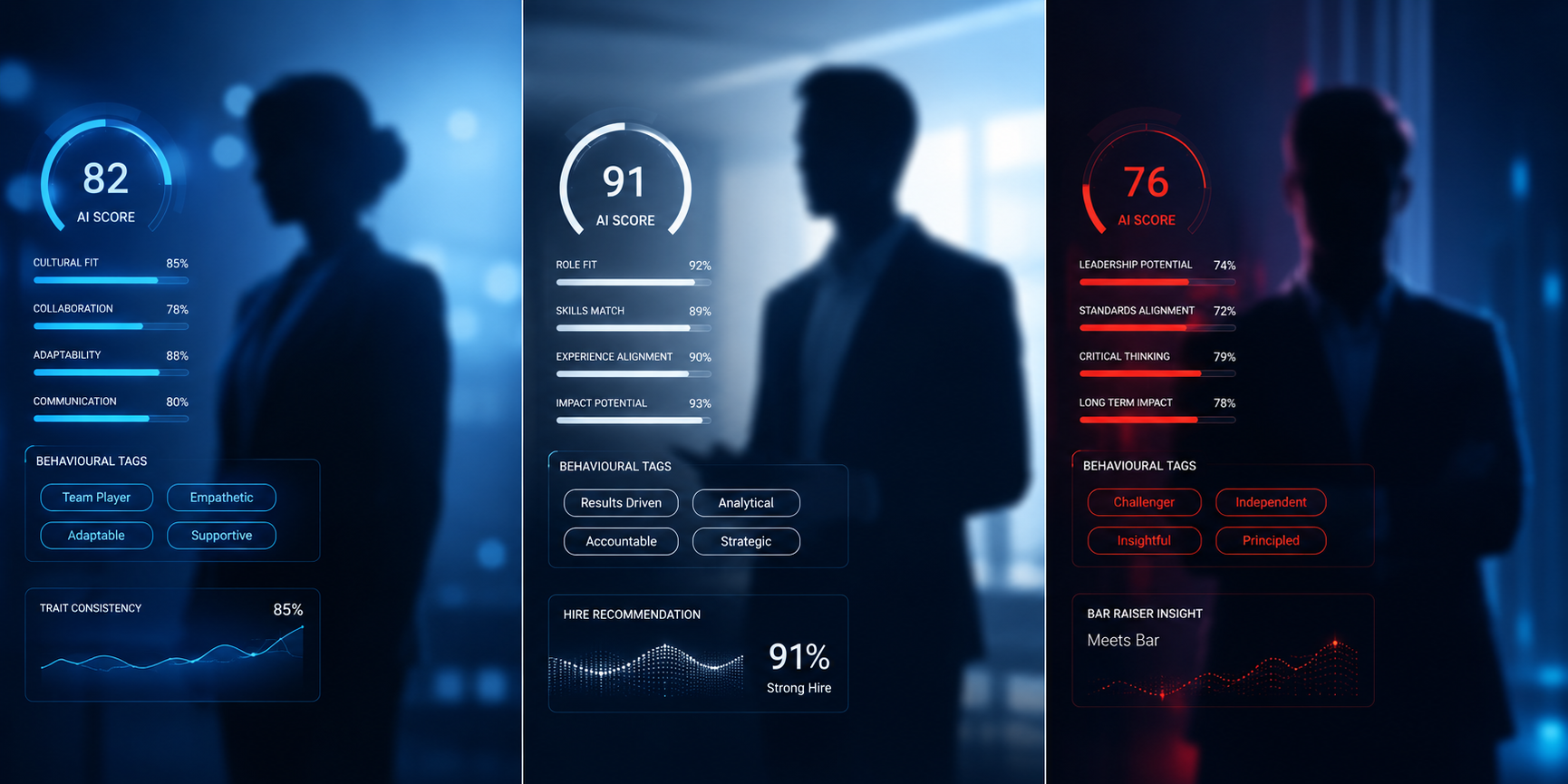
AI Interview Personas Explained: Friendly HR vs. Hiring Manager vs. Bar Raiser
Most candidates prepare for interview questions, but successful candidates prepare for interviewers. HR Screeners, Hiring Managers, and Bar Raisers each evaluate completely different signals during the hiring process. This guide explains how every interview persona thinks, what they are really assessing, the common mistakes candidates make at each stage, and how AI interview persona selection helps you practice with the right level of pressure, feedback, and evaluation criteria before the real interview.
AI Interview Personas Explained: Friendly HR vs. Hiring Manager vs. Bar Raiser
Key Takeaway
Most candidates practice on a single generic mode - and assume the real interview will feel similar. It won't. AI interview persona selection is one of the most overlooked advantages in modern interview preparation. MockWin's Normal Mode covers the HR Screen and Hiring Manager dynamic. Bar Raiser Mode is the high-friction advanced setting - adversarial follow-ups, zero hints, benchmarked against higher-performance expectations. Practice both. Read the gap. Land the offer.
In This Article
Most candidates prepare for job interviews the way they crammed for exams: repeat the same material until it feels familiar. That's not preparation. That's comfort. And comfort doesn't win offers.
Most candidates focus on interview questions. The strongest candidates prepare for different interviewer expectations. AI interview persona selection helps bridge that gap. The assumption that one practice mode covers everything doesn't hold. A Friendly HR screener is testing whether you'll survive the process. A Hiring Manager is deciding whether you'll make them look good. A Bar Raiser is deciding whether you'll raise the floor for everyone after you.
Each type follows a different logic, rewards different signals, and exposes different gaps. If your practice doesn't account for that, you're letting the algorithm - and the human behind it - make the decision for you.
This guide breaks down each interviewer type, what they're actually optimising for, and how to use MockWin's adaptive interview modes to stop guessing and start proving readiness.
What Is an AI Interview Persona?
An AI interview persona is a configurable interview mode that replicates the behavioural style, question priorities, and evaluation criteria of a specific type of human interviewer. Instead of a generic question bank, a persona-based AI simulator adapts its follow-up depth, pressure level, and scoring rubric to match the real-world dynamics of that interviewer type.
MockWin runs two primary modes that cover the full hiring loop:
- Normal Mode - replicates the interview dynamics most candidates encounter across rounds: the qualifying HR screen and the outcome-focused Hiring Manager deep dive. Warm, structured, and calibrated to your role and resume.
- Bar Raiser Mode - MockWin's advanced simulation. Higher friction, zero hints, and scoring benchmarked against higher-performance expectations - the standard a senior interviewer would apply.
Getting AI interview persona selection right means you're not just practicing answers - you're practicing the right answers for the right audience, against a standard that reflects where the real pressure lives.
See how MockWin's adaptive interview modes work for hiring teams →HR vs. Hiring Manager vs. Bar Raiser: Key Differences
Before breaking down each interviewer in detail, here's the quick view. The same answer can land very differently depending on who is asking - because each role is listening for a different signal.
| Interviewer | Optimising For | Common Mistake | Best Practice |
|---|---|---|---|
| HR Screener | Communication & fit | Rambling | Clear, concise narrative |
| Hiring Manager | Outcomes | Weak metrics | STAR + quantified impact |
| Bar Raiser | Judgment | Generic leadership answers | Trade-off reasoning |
One answer, three reactions
To make this concrete, picture the same starting answer - "I led a migration project" - moving through all three interviewers:
May accept the broad answer as-is: it's clear, it signals ownership, and it moves you forward.
Will press for measurable impact: "What changed as a result? What was the scope, and what was your specific contribution?"
May ask why you chose that strategy over the alternatives - and what trade-offs you accepted to get there.
Interviewer Type 1: The Friendly HR Screener
What this interviewer is optimising for
The HR screener's job is triage, not selection. They're filtering for clear disqualifiers: salary misalignment, availability, communication clarity, and culture red flags. They are not deep-diving on technical depth or leadership judgment. Their decisions are binary: advance or screen out.
Their questions typically cover:
- Career trajectory and motivation ("Why are you leaving your current role?")
- Role logistics ("What's your timeline and notice period?")
- Compensation alignment
- Surface-level culture fit
How to practise for the HR Screener in MockWin Normal Mode
In MockWin Normal Mode, the opening round is intentionally warm and conversational - mirroring what a real HR screener sounds like. Question pacing is measured. Follow-up prompts are light. The scoring priority is clarity and confidence, not depth.
The trap most candidates fall into: they under-prepare for this round because it feels easy. Then they stumble on the salary conversation, give a rambling answer to "tell me about yourself," or fail to communicate their career arc cleanly.
💡 What to Practise
Your 90-second career narrative. Your compensation range with rationale. Your "why this company" answer. These need to land in under two minutes, every time. No "um." No backtracking. Run at least two sessions in MockWin Normal Mode focused purely on opener clarity before you face a real screen.
Interviewer Type 2: The Hiring Manager
What this interviewer is optimising for
The Hiring Manager has a problem to solve and a team to protect. They're not just evaluating you against the job description - they're projecting you six months into the role. Will you reduce their load or add to it? Will you collaborate well with the people already on their team? Do your past results map to the results they need next quarter?
Their questions are role-specific, outcome-focused, and structured around the STAR framework (Situation, Task, Action, Result). They'll probe for scope, ownership, and measurable impact. Vague answers don't just score low - they signal risk. MockWin's role-specific interview library covers 500+ questions across every major job function.
How to practise for the Hiring Manager in MockWin Normal Mode
In MockWin Normal Mode, the Hiring Manager round increases question specificity and follow-up pressure. If you give a vague answer, the simulator probes: "What was the actual result? What was your specific contribution vs. the team's?"
The STAR Analysis in your MockWin performance report shows exactly where your answers broke down - missing Result, thin Action, no scope signal. This is where MockWin's STAR feedback engine earns its keep. Candidates who practice only in a generic mode consistently over-narrate the Situation and under-deliver on the Result. MockWin surfaces that gap after every single session with a score you can act on.
📊 The STAR Gap Most Candidates Don't See
In a typical uncoached behavioral answer, candidates spend 60-70% of their time on Situation and Task, and under 20% on the Result - the only part the Hiring Manager actually scores on. MockWin's STAR Analysis shows this breakdown visually after every session.
💡 What to Practise
Build a bank of 8-10 role-specific STAR stories. Each one should close with a quantified outcome and a single-sentence takeaway. Time them. If your answer runs past three minutes, you've lost the room. Run at least 5 sessions in MockWin Normal Mode (Hiring Manager focus) before any live loop.
Interviewer Type 3: The Bar Raiser
What this interviewer is optimising for
The Bar Raiser is the most misunderstood interviewer in any hiring loop. Originating from Amazon's hiring methodology, the Bar Raiser is a trained, independent evaluator from outside the hiring team. They have a single mandate: ensure the candidate raises the median quality of the organisation - not just fills the open role.
Because they have no personal stake in the headcount being filled - and in many hiring loops can veto the Hiring Manager's preference - they evaluate with a longer time horizon. They're asking: Will this person be in the top 50% of everyone at this company doing this kind of work, two years from now?
Their questions focus on:
- Leadership principles and values under pressure
- Cross-functional influence and judgment calls
- Long-term ambition and learning trajectory
- Situations where you disagreed with a decision and how you handled it
How to practise with MockWin Bar Raiser Mode
MockWin Bar Raiser Mode is the highest-friction setting on the platform - and it's deliberately uncomfortable. It runs as a real-time AI voice interview, introduces adversarial follow-ups, challenges the logic of your past decisions, and gives you zero hints when you stall.
Answers that rely on vague leadership language - "I'm a team player," "I believe in ownership" - receive low scores. The model is calibrated to reward demonstrable judgment and intellectual honesty. Every answer is benchmarked against what a senior leader two levels above the role would find credible, not what sounds polished.
💡 What to Practise
Prepare for the "Tell me about a time you disagreed with your manager" question - and every variant of it. Prepare stories where you took an unpopular position with data, and stories where you changed your mind based on new evidence. The Bar Raiser is looking for intellectual integrity, not bravado. Run at least 3 sessions in MockWin Bar Raiser Mode before any senior-level loop.
How to Sequence Your AI Interview Persona Selection
AI interview persona selection isn't a one-time decision - it's a strategy you build across your prep timeline.
- Early in your prep (2-3 weeks out): Run MockWin in Normal Mode focused on the Hiring Manager dynamic. Build your STAR story library and get reps on role-specific questions. This is your highest-volume practice phase - aim for 5+ sessions.
- Mid-prep (1-2 weeks out): Activate MockWin Bar Raiser Mode for 30% of your sessions. The feedback will be harder. That's the point. It surfaces gaps in your reasoning and values-based answers before the real interview exposes them.
- Final week: Return to Normal Mode with an HR Screener focus. Polish your narrative, your compensation positioning, and your opener. The first impression is set in this round - and it's rarely recovered from.
📈 The Readiness Signal to Watch
When your MockWin Bar Raiser score consistently matches your Normal Mode score, you're ready. If there's a gap of more than 15 points between them, prioritise the weaker mode until it closes. That gap is the single most reliable predictor of interview risk. Want to benchmark yourself against real candidates? Try MockWin's Challenge Mode - same interview setup, ranked against peers.
Frequently Asked Questions
Q What is an AI interview persona?
An AI interview persona is a configurable interview mode that mirrors the evaluation priorities, tone, and follow-up behaviour of a specific type of real-world interviewer - such as an HR screener, Hiring Manager, or Bar Raiser. Platforms like MockWin use this to let candidates practice under realistic, pressure-matched conditions rather than against a static question bank.
Q What is the difference between a Hiring Manager and a Bar Raiser interview?
A Hiring Manager interview focuses on role competency, team fit, and near-term impact. A Bar Raiser interview is conducted by a trained independent evaluator who assesses long-term organisational contribution and can veto the Hiring Manager's recommendation. The Bar Raiser's questions go deeper on values, judgment, and intellectual integrity - and MockWin's Bar Raiser Mode replicates this pressure directly.
Q How does AI interview persona selection improve readiness?
By practicing against mode-specific scoring rubrics, candidates receive targeted feedback on the gaps that actually matter for each interviewer type. A generic practice session doesn't replicate the follow-up pressure of a Bar Raiser or the pacing of an HR screen - MockWin's AI interview persona selection closes that gap and delivers a readiness score after every session.
Q Should I use Bar Raiser Mode even for non-Amazon roles?
Yes. Any senior role at a company with a structured interview loop - top-tier tech and consulting firms, growth-stage tech, consulting - will include at least one interviewer whose logic mirrors the Bar Raiser framework. Practicing MockWin's Bar Raiser Mode builds the intellectual rigour that distinguishes strong candidates in any debrief, not just Amazon loops.
Q What does STAR feedback mean in AI interview practice?
STAR (Situation, Task, Action, Result) feedback is structured scoring that evaluates whether a behavioural answer contains all four components - and whether the Result is specific and quantified. MockWin's STAR Analysis scores every behavioural answer on this framework and shows exactly where your responses are incomplete from a Hiring Manager's perspective.
Q How many sessions should I do in each mode before a real interview?
A minimum of 5 full sessions in Normal Mode (Hiring Manager focus), 3 in Bar Raiser Mode, and 2 in Normal Mode (HR Screener focus) - for a total of at least 10 practice interviews per application cycle. MockWin readiness scores above 80 across both modes correlate with significantly higher offer confidence (est.).
Stop Guessing. Start Proving.
Static prep is dead. MockWin's adaptive AI interview modes - Normal and Bar Raiser - give you the unfair advantage every serious candidate needs.
Most candidates prepare for interview questions. Top candidates prepare for interviewers. AI interview persona selection helps close that gap through realistic, role-specific practice.
Tags
Shaik Vahid
Content Writer and SEO Specialist crafting impactful, search-optimized content that drives visibility blending creativity with data to deliver meaningful results.