
Can AI Detect Confidence in Interviews?
Can AI really detect confidence in interviews? See how voice, face, and language signals are measured, what research shows, and how to build confidence AI will notice.
Confidence in Interviews
Quick Answer
Yes to a real but limited degree. AI can measure proxies for confidence: voice steadiness, pitch variation, pacing, word choice, posture, and eye contact. It cannot read your actual feelings, only the outward signals that usually correlate with them. That's why the most useful AI interview tools don't just score you they show you exactly which signal dragged your score down so you can practice and fix it before the real interview.
On This Page
- What "AI detecting confidence" actually means
- How AI measures confidence: the four signal types
- What the research actually shows
- Where AI gets it right and where it doesn't
- Why this matters for job seekers
- How to build confidence AI (and humans) will actually notice
- How Mockwin.ai turns this into practice you can use
- Frequently asked questions
You walk out of an interview feeling like you nailed it. Two weeks later: silence, or a rejection email. Somewhere between how you felt and how you came across, something got lost and increasingly, it's an AI system that's trying to measure that gap. Video-interview platforms, applicant tracking tools, and AI mock-interview coaches all claim some version of the same thing: they can tell how confident you sounded and looked. But can software really detect something as internal as confidence, or is this just a clever-sounding feature with shaky science behind it?
This is the question we're answering properly not with marketing claims, but with what the underlying technology can and cannot actually do.
What "AI Detecting Confidence" Actually Means
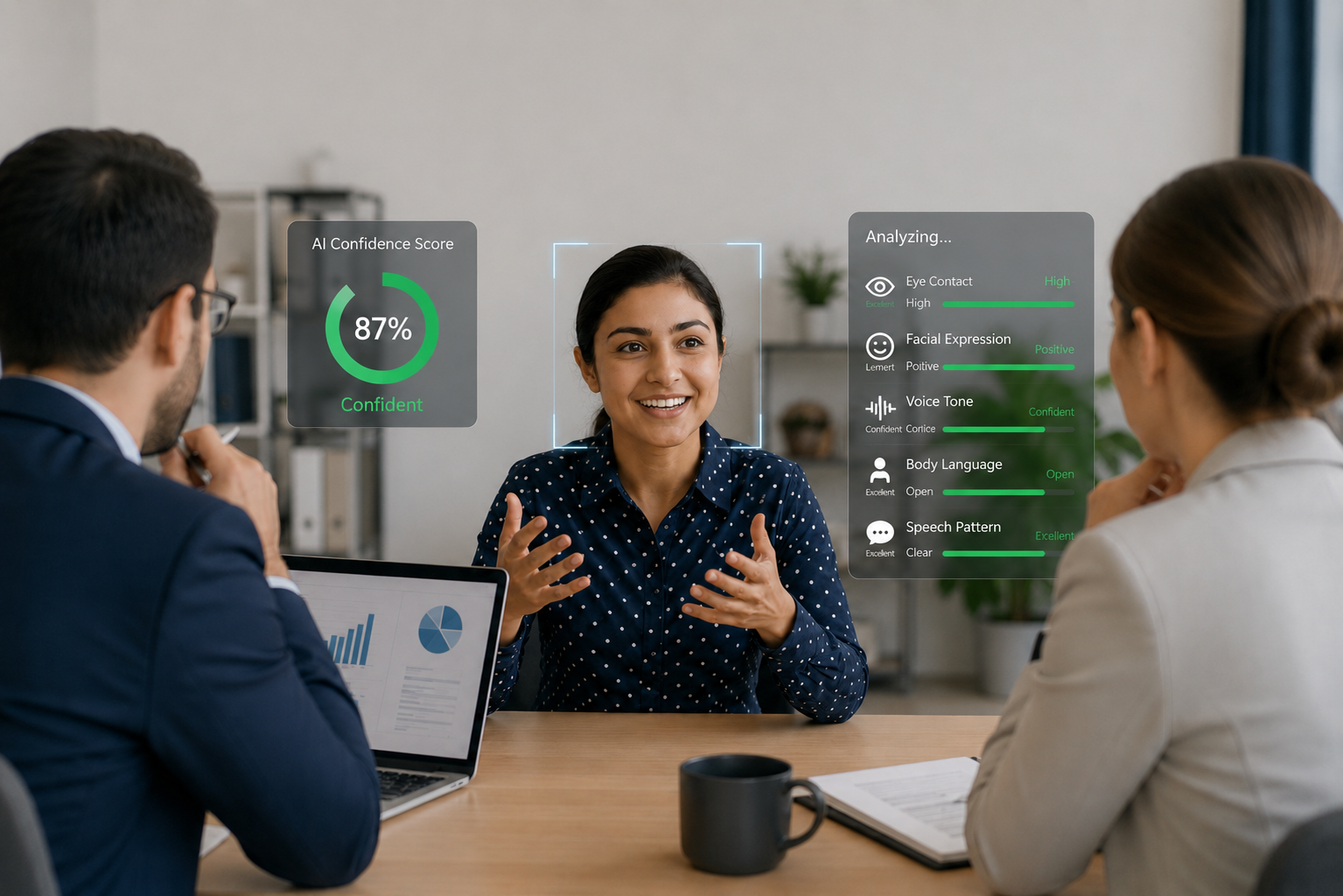
Confidence isn't a single measurable thing it's an internal state. AI systems don't read minds; they read behavioral proxies observable patterns in your voice, face, posture, and language that are statistically associated with how confident a person appears to others. This distinction matters enormously: AI is detecting perceived confidence, not felt confidence. A naturally calm person can come across as low-energy and unconfident to an algorithm, while a nervous person who has rehearsed their delivery can score as highly confident.
So the honest answer to "can AI detect confidence" is: AI can detect the outward signals of confidence with reasonable consistency, but it is measuring presentation, not psychology.
How AI Measures Confidence: The Four Signal Types
Modern AI interview systems typically combine several layers of analysis rather than relying on one signal alone. Here's what's actually being measured behind the scenes.
🎙️ Vocal signals
This is where the science is strongest. AI breaks your voice into acoustic features pitch range, prosody, pacing, and pause patterns and compares them against patterns associated with confident delivery. A narrow, flat pitch range combined with frequent filler words and long hesitations tends to score as lower confidence. Steady pacing, controlled pauses, and natural pitch variation tend to score higher.
📹 Facial and posture signals
In video interviews, computer vision models analyze micro-expressions, eye contact patterns, head movement, and posture stability. This branch of facial expression analysis uses deep learning trained on labeled emotional datasets to flag signs of nervousness fidgeting, gaze avoidance, tense expressions versus signs of composure.
📝 Linguistic signals
What you say matters too. Hedging language ("I think maybe," "sort of," "I'm not really sure"), excessive qualifiers, and circular answers are linguistic markers that NLP models associate with uncertainty. Direct, structured answers with clear ownership ("I led this," "I decided to") tend to score as more assertive.
⏱️ Behavioral timing
Response latency how long you take before answering, and how consistent your pacing is across a full interview is increasingly used as a supporting signal, since hesitation under pressure is one of the more reliable nonverbal indicators of uncertainty.
The fusion approach
No serious AI system scores confidence from a single signal. The most reliable models combine vocal, visual, and linguistic data, because any one signal in isolation is easy to misread a soft-spoken person isn't necessarily an unconfident one.
What the Research Actually Shows
It's worth separating product marketing from peer-reviewed evidence. Independent research backs up the core premise that confidence leaves measurable traces in voice and face but it's also realistic about the limits.
A study on vocal emotion recognition found that acoustic parameters in speech provide sufficient discrimination between emotional categories to permit accurate statistical classification, and that listeners who were better at recognizing vocal emotion were also more confident in their own judgments suggesting confidence really does have a detectable acoustic signature, for both human listeners and machine classifiers.
On the computer vision side, researchers studying facial expression analysis in AI-driven video interviews describe how deep learning systems built on facial action coding can convert subtle emotional cues including confidence, nervousness, and eagerness into structured, repeatable data, something human reviewers struggle to do consistently due to bias and fatigue.
Meanwhile, a separate study on AI-driven mock technical interviews found that repeated practice with a multimodal AI interview system increased participants' confidence and improved how clearly they articulated their reasoning which matters for a different reason: AI isn't just detecting confidence, it's actively helping people build it through low-pressure repetition.
Where AI Gets It Right And Where It Doesn't
This is the part most "yes, AI can read confidence" articles skip. Accuracy depends heavily on conditions, and treating an AI confidence score as gospel is a mistake.
| Condition | How AI tends to perform |
|---|---|
| Clear audio, good lighting, native-language fluency | Strong signals are clean and consistent with training data |
| Background noise, poor camera angle, low bandwidth | Weaker visual and audio signals get distorted or lost |
| Neurodivergent communication styles, accents, cultural variation in expressiveness | Inconsistent models trained on narrow datasets can misread normal variation as low confidence |
| Rehearsed, structured answers | Strong pacing and language patterns are easy to evaluate |
| Genuinely calm but reserved communicators | Risk of underscoring quietness is not the same as a lack of confidence |
Cultural & individual variation
Expressiveness norms differ across cultures and personalities. A model trained mostly on one communication style can misjudge another as "less confident."
Performed vs. genuine confidence
AI scores presentation, so a well-rehearsed but hollow answer can outscore an honest, slightly hesitant one.
Technical conditions
A bad mic or laggy video can distort vocal and visual signals enough to drag down a score that has nothing to do with you.
Context blindness
AI doesn't know you're nervous because this is your first interview after a layoff it only sees the surface signal, not the reason behind it.
Important nuance
No credible AI system should be used to make a final hiring decision based on a "confidence score" alone. Reputable platforms position confidence analysis as coaching feedback for candidates or one input among many for recruiters not a standalone verdict on someone's ability to do the job.
Why This Matters for Job Seekers
Whether or not you love the idea, the trend is real: more interviews now run through some layer of AI evaluation, whether it's an asynchronous video screen, a real-time AI interviewer, or a recruiter using AI-assisted scoring behind the scenes. Understanding what's actually being measured changes how you prepare.
The practical upside
If AI can detect the signals of low confidence rushed speech, filler words, monotone delivery, gaze avoidance it can also detect when those signals improve with practice. That turns "be more confident" from vague advice into something you can actually train and measure.
How to Build Confidence AI (and Humans) Will Actually Notice
Practice out loud, not just in your head
Mental rehearsal doesn't train your pacing or pitch control. Speaking your answers aloud, repeatedly, is what actually smooths out the vocal hesitations AI (and interviewers) pick up on.
Record yourself and watch it back
Most people are unaware of their own filler words, gaze drift, or fidgeting until they see it. This is uncomfortable but it's the fastest way to close the gap between how you feel and how you come across.
Structure your answers before you speak
Hesitation often comes from not knowing where an answer is going. A simple structure situation, action, result removes the need to "figure it out" mid-sentence, which is what produces hedging language.
Practice under realistic pressure
Confidence built in a relaxed setting often disappears the moment real stakes show up. Practicing with timed, role-specific questions builds the kind of composure that holds up in the actual interview.
Get feedback on the signal, not just the content
Knowing your answer was good isn't enough if your delivery undercut it. Feedback that separates "what you said" from "how it came across" is what actually moves the needle on perceived confidence.
How Mockwin.ai Turns This Into Practice You Can Use
This is exactly the gap Mockwin.ai is built to close. Instead of guessing whether you "seemed confident," you practice with an AI interviewer that listens to your pacing, tone, and answer structure, and gives you specific, actionable feedback not just a generic score.
If you want to start with your own background instead of generic questions, you can run a session through resume-based interview practice, which builds questions directly from your experience. Prefer to simulate real interview pressure end to end? Try a real-time AI interview session, or push yourself further with challenge mode for high-pressure practice rounds.
For ongoing support beyond mock sessions, the AI interview assistant helps you prepare answers and structure responses ahead of time, while the adaptive AI mock interviewer is the core engine behind all of this learning from your responses in real time rather than running a fixed script.
Stop Guessing How You Come Across
Practice with an AI interviewer that measures your pacing, tone, and delivery then shows you exactly what to fix before the real thing.
Frequently Asked Questions
Can AI tell if I'm faking confidence?
To a degree, yes. AI is harder to fool with surface-level performance than most people assume, because it cross-checks multiple signals vocal, visual, and linguistic at once. Inconsistency between these signals (confident words but a shaky voice, for example) is itself a pattern models can pick up on.
Is an AI confidence score the same as a hiring decision?
No. Reputable AI interview tools treat confidence analysis as one data point or as coaching feedback, not a standalone hiring verdict. Most use it to surface delivery patterns to candidates or recruiters alongside the actual content of the answers.
Does AI confidence detection work the same for everyone?
Not perfectly. Accuracy can vary across accents, cultural communication styles, and individual personality types, since models are trained on specific datasets. This is a known limitation, and it's part of why human review still matters alongside AI scoring.
Can practicing with AI actually improve how confident I sound?
Yes. Because AI measures specific, trainable signals pacing, filler words, pitch variation, answer structure repeated practice with feedback on those exact signals is one of the more direct ways to improve how confident you come across, separate from how you feel internally.
What's the difference between AI detecting confidence and AI detecting cheating?
These are different systems. Confidence detection analyzes delivery tone, pacing, body language. Integrity or proctoring systems look for unrelated signals like screen switching or unnatural response patterns. A candidate can score high on confidence and still be flagged for unrelated integrity concerns, or vice versa.
Tags
Neelekhana
Content Writer and SEO Specialist crafting impactful, search-optimized content that drives visibility blending creativity with data to deliver meaningful results.
Related Articles

FAANG Interviews
Learn how to use AI to prepare for FAANG interviews coding, system design & behavioral rounds. A step-by-step AI prep system to land top-tech offers.
Voice-Based AI Interview Practice: Complete Guide
Practice interviews out loud with adaptive voice-based AI. Get instant feedback on pacing, filler words, STAR structure and confidence built for real hiring rounds.

30-Day Interview Preparation Plan with AI
Transform your interview prep with a structured 30-day AI study plan. Learn how to use adaptive mock interviews to build skills, fix weak spots, and land the job.